

Understanding Binary to Decimal Conversion
🔢 Learn how to convert binary numbers to decimal with clear steps, practical examples, and tips to avoid common mistakes in computing and everyday use.
Edited By
Charlotte Evans
Decimal and binary are two number systems that serve different purposes in computing and daily life. The decimal system, based on ten digits (0 to 9), is what we use for everyday counting and financial transactions. Binary, on the other hand, uses only two digits—0 and 1—and forms the backbone of digital computing. Understanding how to convert decimal numbers into binary is valuable for traders analysing algorithmic trading systems, students studying computer science, and analysts working with digital data.
Online conversion tools simplify this process significantly. Instead of performing manual calculations, you can quickly convert decimal numbers into binary format with just a few clicks. These tools provide accurate results, saving time and reducing mistakes. For example, converting Rs 250 to binary manually might take time, but an online tool can give you the binary equivalent "11111010" instantly.

Speed: Converts instantly without manual effort.
Accuracy: Minimises human error, essential for precise computations.
Accessibility: Available anytime on phones or computers without software installation.
Learning Aid: Helps students understand the number system conversions by showing stepwise results.
Not all converters deliver the same level of accuracy or user experience. Look for these features:
Clear input fields for decimal numbers.
Instant conversion without delays or unnecessary ads.
Option to convert large numbers, which is useful for financial data in crores.
Support for negative numbers if needed.
Additional features like decimal to hexadecimal or octal conversions can be a plus.
Reliable converters usually mention their calculation methods or include references to standard algorithms for number conversions.
Using these online tools can assist you in making swift financial decisions or better understanding of computer data formats. For traders and brokers, it can aid in analysing indicators built on binary operations, while students can apply these conversions in programming or electronic circuits coursework.
Understanding decimal and binary number systems is key when you work with numerical data, especially in fields like computing, finance, or engineering. The decimal system is the one we use daily, so grasping its basics helps relate everyday numbers to their digital equivalents. On the other hand, knowing the binary system is essential for understanding how computers process and store information.
The decimal number system uses base 10, meaning it has ten unique digits: 0 through 9. This system is practical because humans naturally count using ten fingers, making it intuitive for daily calculations, shopping bills, and financial transactions. For example, when you see Rs 2,500 on your electricity bill, that number is expressed in the decimal system.
Place value is what makes the decimal system powerful. Each digit’s position determines its actual value. In Rs 2,500, the '2' is in the thousands place and actually means two thousand, while the '5' represents five hundreds. The further left a digit is, the higher its value by powers of 10. This positional system lets us easily write and handle large numbers without confusion.
Binary is a base 2 system, which means it uses only two digits: 0 and 1. This simplicity fits perfectly with electronic circuits, where switches have two states: on and off. For instance, a binary number like 1011 represents a specific value by combining these bits, each with increasing powers of 2.
In computing, binary is the language of machines. Every piece of digital data—from simple text to complex images—is encoded in binary. When a computer processes instructions or stores data, it translates decimal numbers into binary strings to communicate internally. For example, the decimal number 13 converts to binary as 1101, which computers easily understand.
Converting decimal numbers to binary is more than a technical exercise; it forms the backbone of how modern computing systems operate. Digital devices rely on binary to process and store information, making this conversion essential for anyone dealing with computers, programming, or digital electronics. For traders and analysts, understanding such basics can deepen one’s grasp of the tech-driven tools and platforms used daily.
Data processing and storage involves representing numbers as a sequence of ones and zeros so computers can handle calculations efficiently. Every file you save, whether a document, image, or video, is ultimately stored in binary. For instance, a 32-bit colour image uses binary representation to define each pixel’s colour precisely. Without converting decimal inputs into binary form, computers couldn’t interpret or store digital data correctly.
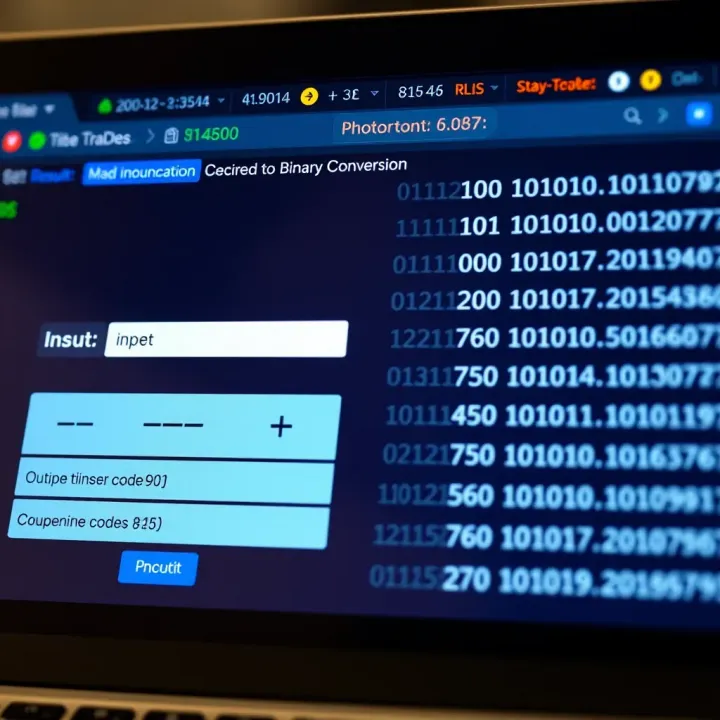
In practical terms, when you use online tools for decimal to binary conversion, it simulates what happens internally in computers, helping to bridge human-readable numbers with machine language. This conversion is especially relevant in Pakistan’s growing IT sector, where efficient data processing plays a critical role in software and app development.
Programming and software development rely heavily on binary understanding. Programmers often encounter binary during tasks such as bitwise operations, memory management, or debugging low-level code. For example, system programmers working on embedded devices or firmware frequently deal with binary data to optimise performance or troubleshoot errors.
Moreover, knowing how decimal translates to binary aids in writing efficient algorithms and understanding how software interacts with hardware. Learning this conversion using online tools can help developers quickly test and verify code segments without manually crunching numbers, saving time and reducing errors.
Learning number systems is a fundamental step in computer science education. For students and self-learners, converting decimals to binary sharpens numerical agility and clarifies how different base systems work. This skill supports subjects like Information and Communication Technology (ICT) at matric and intermediate levels, often critical for examinations.
Online converters make this learning process interactive and accessible. They provide instant results and allow learners to experiment with various numbers, which helps in internalising concepts without getting bogged down by manual calculations.
Supporting digital electronics studies is another vital reason to master decimal to binary conversion. Digital circuits, such as adders, flip-flops, and multiplexers, function based on binary logic. Students and engineers using online tools can easily verify the outputs from their circuit designs by comparing expected binary values.
In practical electronics labs across Pakistani universities, these tools save time and reduce mistakes, helping students focus on understanding circuit behaviour rather than arithmetic details. This facilitation enhances the quality of hands-on learning and prepares students for industrial challenges.
Understanding why and how to convert decimal to binary equips you with the foundation to engage confidently with modern technology, whether you are coding, analysing data, or working on electronic designs.
Online converters make decimal to binary conversion accessible for everyone, be it students, analysts, or traders. Instead of manual calculations, which can be time-consuming and prone to error, these tools offer quick and reliable answers. The usefulness goes beyond classrooms — software developers working on embedded systems or brokers developing algorithmic trading strategies often need to switch between number systems precisely. Online tools simplify this, saving both effort and time.
Accuracy and user-friendliness rank highest when choosing a converter. An accurate tool must handle various decimal inputs, including large values, and provide the correct binary equivalent each time. Ease of use means a simple interface without unnecessary clutter, allowing quick entry and clear output so users can convert numbers without confusion or delay.
Some converters also provide features like copying results with one click or explaining the conversion process step-by-step, which can help deepen understanding rather than just giving an instant answer.
For Pakistani users, platforms like "CalculatorSoup" and "RapidTables" from abroad are widely used for their clarity and reliability. Locally, some educational websites integrate conversion tools tailored to Pakistani syllabi, which might support Urdu instructions or contextual examples. Choosing a known and trusted source reduces the chance of receiving incorrect output.
Start by entering your decimal number precisely — avoid including commas or spaces, as not all converters handle them well. For example, to convert Rs 1200, simply type "1200". Negative numbers may require specific handling, so check if the tool supports signed values if needed.
After inputting the number, submit it for conversion. The tool will output a binary number, typically a sequence of 0s and 1s. For instance, 1200 in decimal converts to 10010110000 in binary.
Reading this output is straightforward once you understand that each digit represents an increasing power of two, starting from the right. This means the rightmost bit is 2^0 (1), the next is 2^1 (2), and so on. Recognising this helps verify the conversion's accuracy or apply the binary value in digital logic or programming tasks.
Using online converters correctly can boost your confidence when working across number systems, especially in fields like digital electronics or computer programming where precise binary values matter.
In summary, reliable online tools offer speed and precision, ensuring anyone needing to convert decimals to binary can do so easily and with confidence.
Basic manual conversion techniques involve converting decimal numbers to binary step-by-step without relying on digital tools. For instance, you repeatedly divide the decimal number by 2, noting down the remainders until you reach zero. Arranging these remainders in reverse gives you the binary equivalent. This process is simple but effective, especially for small numbers, helping you confirm if an online tool's output matches manual calculations.
Manual conversion acts as a safety net, especially for students or professionals learning binary systems. By understanding how conversion works on paper, you get a better feel for verifying results from automated sources. For example, converting decimal 13 manually:
13 ÷ 2 = 6, remainder 1
6 ÷ 2 = 3, remainder 0
3 ÷ 2 = 1, remainder 1
1 ÷ 2 = 0, remainder 1
This results in 1101 in binary, which should match the online tool's output.
Comparing manual and online results is the next logical step. After performing manual conversion, input the same decimal number into your chosen converter. If both results align, you can trust the online tool for similar cases. But if there's a discrepancy, it may indicate input errors, tool limitations, or bugs. Regularly cross-checking helps catch such issues early.
For instance, if you convert 45 manually and get 101101 but the tool shows 101110, something’s off. Either your input was wrong, or the converter failed to process it correctly. Comparing results boosts your confidence in the tools, especially when dealing with larger numbers or complex conversions.
Input mistakes are among the most common reasons for incorrect binary results. Users often enter invalid characters, extra spaces, or forget to use the correct decimal format. For example, typing " 123 " with leading or trailing spaces might confuse some converters, leading to errors or wrong outputs. Always ensure you're typing valid numbers without unnecessary symbols.
Another frequent slip-up is confusing decimal points with commas. In Pakistan, we might say 1,230 (one thousand two hundred thirty) but some converters misinterpret commas, causing errors. Stick to plain numbers like 1230 for smooth conversions.
Limitations of some converters can affect result accuracy too. Not all online tools handle very large numbers correctly or support fractional decimal inputs. Some free converters only accept integers, while others may round off results inaccurately.
Additionally, some converters rely on outdated scripts or have poor error management, resulting in incorrect binary strings or crashes. For example, a converter might fail when converting Rs 123456789 due to number size limits. It's wise to test multiple converters or pick ones with good reviews and regular updates—preferably those known in Pakistani educational or tech circles.
Always keep manual verification handy and don’t assume any online tool is foolproof. This practice saves time and stress, especially when converting for precise computations or programming tasks.
Consistency and caution in using online decimal to binary converters prevent mistakes that could ripple into bigger issues, whether you're a student working on exams or an analyst handling data conversion tasks.
Understanding how to convert decimal numbers to binary using online tools is more effective when you supplement it with practical tips and additional resources. These help you deepen your grasp of number systems and the real-world applications of binary data. For those involved in trading, software development, or any field relying on digital systems, this knowledge sharpens analytical skills and problem-solving ability.
Recommended books and online courses play a key role in building a solid foundation. For instance, "Discrete Mathematics and Its Applications" by Kenneth Rosen offers clear explanations of number systems and their mathematical backgrounds. In Pakistan, platforms like Coursera and Udemy provide courses on computer science basics, including binary arithmetic and logic. Such structured learning helps students and professionals link online conversion tools to underlying principles, ensuring they comprehend not just the "how" but also the "why".
On the other hand, using apps for practice brings theory into everyday use. Apps like "Binary Game" and "Learn Binary" test and reinforce your binary conversion skills interactively. These are useful for traders and analysts wanting quick mental arithmetic skills for tech-heavy sectors. Practising on mobile apps makes learning continuous and engaging, fitting into busy schedules without needing dedicated study time.
Understanding digital circuit design basics explains the practical side of binary conversion. Binary numbers form the backbone of logic gates and circuit operations common in electronics used daily—from ATM machines to mobile phones. Learners familiar with binary representation find it easier to grasp how information flows through chips and processors, aiding those interested in hardware aspects or embedded systems.
In software testing and debugging, binary conversions help identify issues at the bit-level, like flag settings or memory addressing problems. Programmers and analysts benefit from converting decimal values to binary when inspecting error codes or data packets. This hands-on approach improves accuracy in testing software behaviour and fixes bugs that might otherwise be hidden in complex decimal values.
Practical use of binary goes far beyond classroom exercises; mastering these conversions strengthens both technical understanding and real-world problem solving across computing and finance.
Overall, combining recommended readings, interactive apps, and awareness of practical applications makes learning decimal to binary conversion both accessible and relevant to multiple professional fields.
🔢 Learn how to convert binary numbers to decimal with clear steps, practical examples, and tips to avoid common mistakes in computing and everyday use.
Learn how to convert binary numbers to decimal with clear examples and tips. Perfect for Pakistani students and professionals improving digital skills 💻📚.
Learn how to convert binary numbers to hexadecimal with clear steps, examples, and practical uses in computing 🖥️. Perfect for those familiar with digital numbering.
Learn how a binary to text converter transforms digital communication by turning binary code into readable text. Explore practical tools, examples, and tips 📲💻.
Based on 14 reviews