

Understanding Binary Subtraction Basics
🔢 Learn how binary subtraction works with clear examples and practical tips. Understand borrowing and two's complement methods used in electronics and computing.
Edited By
Emily Clarke
Binary subtraction is a fundamental operation in digital electronics and computer science, essential for arithmetic calculations in computing devices. Unlike decimal subtraction, binary subtraction works only with two digits—0 and 1—but follows systematic rules that enable precise computation.
At its core, binary subtraction involves comparing bits at corresponding positions and borrowing when necessary, similar to how decimal subtraction works but with base 2 arithmetic. This simplicity makes it efficient for processors, which rely heavily on binary maths.

Consider the binary numbers 1011 (which equals 11 in decimal) and 110 (6 in decimal). To subtract 110 from 1011, you align the bits and subtract each one, borrowing from higher bits when the top bit is smaller than the bottom bit:
1 (top) - 0 (bottom) = 1
1 (top) - 1 (bottom) = 0
0 (top) needs to borrow since 0 1, so borrow 1 from next bit
After borrowing, subtract 10 (2 in decimal) - 1 = 1
The result is 101 (5 in decimal), showing how binary subtraction mimics decimal subtraction but respects binary digit limits.
Binary subtraction is crucial not just for basic arithmetic but also for operations like CPU instructions, digital signal processing, and error detection in data transmission.
There are multiple methods to perform binary subtraction:
Direct subtraction with borrowing: Same approach as manual decimal subtraction, handling borrows bit by bit.
Two's complement subtraction: Converts the subtraction into addition by negating the second number using two's complement, simplifying hardware implementation.
For traders and analysts dealing with digital systems or programming trading algorithms, understanding these basics helps in optimising computational tasks and troubleshooting errors.
In summary, binary subtraction forms the backbone of digital arithmetic underpinning computers and digital devices. Mastery of its rules and methods aids both practical computing and grasping how machines handle data internally.
Understanding binary numbers forms the foundation for grasping how binary subtraction works. Since computers operate using binary (a system of only two digits), knowing what binary numbers are and how they differ from the decimal system helps you appreciate the underlying logic behind digital arithmetic.
Binary numbers use just two digits: 0 and 1. Each digit in a binary number is called a bit, and its position indicates its value. For instance, the binary number 1011 represents decimal 11, calculated as 1×2³ + 0×2² + 1×2¹ + 1×2⁰. This simple system powers every calculation in computers, from basic operations to complex algorithms.
Using binary lets computers perform calculations efficiently because electronic circuits easily distinguish between two voltage levels—high (1) and low (0). For example, when your mobile’s processor adds two numbers, it manipulates these bits directly. This makes binary numbers practical and essential for all digital devices around us.
Decimal numbers consist of ten digits (0 to 9), which most people use daily for counting and transactions. Each place value in decimals is a power of 10. For example, in 345, the 3 stands for 3×10², the 4 for 4×10¹, and the 5 for 5×10⁰.
Binary works similarly but with powers of 2. This difference causes some operations to be done differently. For instance, subtracting 1 from 10 in decimal is straightforward, but in binary (10₂), it requires borrowing from the left bit because only digits 0 and 1 are allowed.
The shift from base-10 (decimal) to base-2 (binary) changes how arithmetic is performed, making understanding these basics crucial for working with binary subtraction.
To illustrate, consider the decimal number 5 and its binary form 101. When you subtract 1, in decimal you get 4; in binary, you subtract 1 from 101, resulting in 100. This simple example shows how binary subtraction follows rules unique to its system.
Knowing these differences helps traders, analysts, and students working on technical projects or studying computing concepts. It also broadens understanding of how digital systems—like stock market algorithms or financial calculators—really function beneath the surface.
By grasping binary basics, you’re better prepared to master binary subtraction methods that follow in this article. This foundation supports deeper learning of how digital machines carry out arithmetic reliably and quickly.
The principles of binary subtraction serve as the foundation for handling calculations in digital systems and computing architectures. Understanding these rules helps simplify complex arithmetic processes, ensuring accurate and efficient operations. Since binary numbers consist of only two digits — 0 and 1 — the subtraction rules rely on relatively straightforward logic, but the nuances of borrowing can make it tricky for beginners. Mastering these principles is essential for anyone working with computer hardware, software development, or digital electronics.
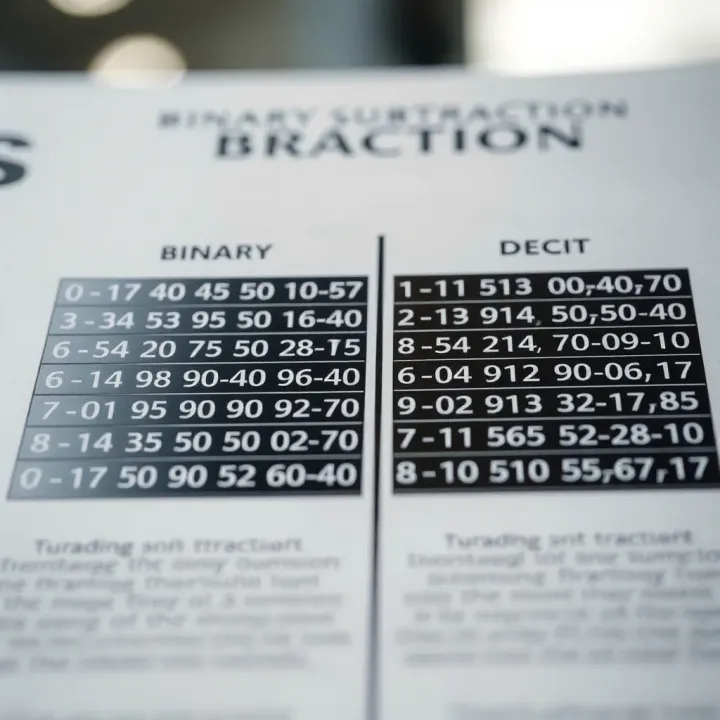
When subtracting 0 from another bit, the process is quite simple. Subtracting 0 from 0 results in 0, naturally, since nothing is taken away. Similarly, subtracting 0 from 1 leaves the digit unchanged at 1. This behaviour reflects the intuitive principle that removing "nothing" does not affect the original number.
For instance, if you have a binary digit 1 and subtract 0, the outcome remains 1. This rule means there is no need for borrowing or special conditions, making it the easiest case in binary subtraction.
Subtracting 1 from 1 also yields 0, since they cancel each other out. However, the challenge comes when you try to subtract 1 from 0. In decimal terms, this would be like asking how to take one out of zero — an impossible operation without borrowing. The same applies here; binary subtraction requires borrowing to handle this.
This is where the binary system borrows from the higher bit, enabling the subtraction to proceed. Without borrowing, subtracting 1 from 0 is undefined. This concept is essential because it underlines the binary system’s need for borrowing, analogous to the decimal system.
Borrowing happens when the subtrahend (the number being taken away) is larger than the minuend (the number from which you subtract) at a specific bit position. Unlike decimal where you borrow a '10', in binary you borrow a '2', as each bit represents powers of two. The borrowed '2' converts the current 0 bit into a 2, allowing the subtraction to continue.
For example, when subtracting 1 from 0 at a certain place, the next left bit which is a 1 turns to 0 after lending its value, while the current 0 becomes 2 (in decimal), allowing the subtraction 2 - 1 = 1. Such borrowing shifts continue leftwards if necessary until a bit with 1 is found. This process is critical because it ensures correctness in binary arithmetic and is widely used in digital circuits and processors.
To see borrowing in action, consider subtracting 1 from 0 in the binary number 10 (two in decimal). Here, the rightmost bit is 0, so subtracting 1 directly is impossible without borrowing. The left bit 1 lends its value, becoming 0, while the right bit turns into 2 (decimal), and then 2 - 1 results in 1. So 10 (binary) minus 1 equals 1.
This borrowing mechanism mirrors everyday decimal borrowing and ensures that binary subtraction remains consistent and reliable across different operations.
Such examples demystify the borrowing process, making it easier for students and professionals alike to grasp the logic behind binary calculations and apply them confidently in computing tasks.
Understanding different methods for binary subtraction is vital because various scenarios in computing require distinct approaches. Most notably, these methods impact how efficiently computers perform arithmetic operations, such as in calculators, processors, and digital systems. Two main approaches are commonly used: direct binary subtraction and subtraction via two's complement. Each has its practical benefits and challenges to consider.
Direct binary subtraction follows the straightforward process of subtracting bit by bit, similar to how you'd subtract decimal numbers by hand. This method is intuitive but can become cumbersome if there are many borrowings involved.
For instance, subtracting 1011 (11 in decimal) from 1101 (13 in decimal) involves observing each bit and borrowing when necessary. While simple for small numbers, this approach needs careful attention in digital circuits since borrow chains may slow down operations. Therefore, direct subtraction is often more educational than practical in computer hardware.
Two's complement simplifies subtraction by converting it into addition. This technique is widely favoured in computing because addition circuits are typically faster and simpler than circuits that handle multiple borrowings.
To subtract one binary number from another using two's complement, you first find the two's complement of the number to be subtracted. This involves two steps: taking the one's complement (flipping all bits) and then adding one to the least significant bit. For example, to subtract 5 (0101) from 9 (1001), convert 5 to its two's complement by flipping bits (1010) and adding one (1011).
This conversion allows the subtraction to be performed as an addition problem: 9 + (-5). It's especially useful because two's complement represents negative numbers naturally, removing the need for separate subtraction circuitry.
After obtaining two's complement, the subtraction is done by simply adding it to the other number. Using the example above, 1001 + 1011 results in 1 0100. The extra leftmost bit (carry) is discarded, leaving 0100, which equals 4 in decimal—the correct subtraction result.
This method reduces complexity in processor design, enabling faster calculations and simpler arithmetic logic units. Most modern CPUs rely on two's complement subtraction for efficiency.
When working within fixed bit lengths, overflow can occur if the result exceeds the allotted bits. In two's complement, overflow is detected if the carry into the most significant bit doesn't match the carry out.
For practical purposes, overflow means the calculation exceeds the range that can be represented. For example, subtracting a larger number from a smaller one in a fixed 4-bit system can cause overflow, resulting in incorrect or wrapped-around values. Detecting overflow is critical for system stability and error handling in computers.
Using two's complement not only streamlines binary subtraction but also ensures that digital systems handle signed numbers effectively, reducing chances of errors in arithmetic processing.
By grasping these binary subtraction methods, traders, analysts, and students can better understand the arithmetic operations behind computing devices they interact with daily. Whether designing algorithms or analysing hardware performance, knowing how subtraction works at the binary level offers practical insights into system behaviour and optimisation.
Understanding how binary subtraction compares with decimal subtraction helps clarify the unique challenges and benefits of arithmetic in digital systems. Since decimals are what we use every day, knowing these parallels and distinctions can aid students, analysts, and traders in grasping how computers perform calculations differently from manual methods. This section breaks down the key similarities and differences with practical examples.
Both binary and decimal subtraction rely on the basic idea of subtracting digits of the same place value, moving from right to left. If the digit in the minuend (top number) is smaller than the digit in the subtrahend (bottom number), then borrowing from the next higher place value is necessary. This borrowing concept is common to both systems.
For instance, when subtracting 54 from 92 in decimal, you borrow 1 from the tens place if needed. Similarly, subtracting 101 (5 in decimal) from 110 (6 in decimal) in binary involves borrowing too. The main principle of ‘if the top digit is smaller, borrow and adjust’ holds true in both cases.
Additionally, both systems go digit by digit and sum up remainders after completing all subtractions to produce the final result. This stepwise method ensures accuracy in any base.
The binary system works exclusively with two digits — 0 and 1 — which simplifies some rules but complicates borrowing. Unlike decimal’s range of ten digits, binary subtraction only has three straightforward immediate subtractions: 0–0, 1–0, and 1–1. When a bit tries to subtract 1 from 0, borrowing becomes essential, but it involves borrowing a '2' (which is 10 in binary) rather than a '10' as in decimal.
For example, subtracting 1 from 0 in binary means borrowing from the next bit, turning the 0 into ‘10’ binary (which is 2 decimal), then performing the subtraction: 10 (2) minus 1 equals 1. This behaviour is distinctive and demands careful attention, especially when working with longer bit sequences.
Moreover, binary subtraction frequently uses Two's Complement method in computing, allowing subtraction by adding the complement of the second number. This is not common in decimal arithmetic, which typically uses direct subtraction and borrowing. Two's Complement handles negative results gracefully, which is crucial in programming and processor design.
While decimal subtraction is intuitive for humans, binary subtraction reflects how computers handle data at the lowest level, where simplicity of digits leads to efficient but specific rules.
In practical terms, this means traders and analysts who deal with digital systems or coding should be clear on these differences to understand calculations performed behind the scenes in software and hardware. It also highlights why errors can occur if binary subtraction rules are misunderstood or misapplied, especially in algorithm design or debugging.
In brief:
Decimal subtraction has a wider digit range and borrowing involves a base ten system.
Binary uses only 0 and 1, meaning borrowing operates with base two and follows stricter rules.
Binary subtraction commonly utilises Two's Complement to simplify hardware operations and handle negatives.
This comparison provides a roadmap to appreciate binary subtraction's role in computing while recognising its differences from the decimal arithmetic familiar to everyday users.
Binary subtraction plays a fundamental role in modern computing. Its practical applications influence everything from simple calculations to complex processor operations. Understanding where and how binary subtraction fits into computing systems helps clarify its value beyond basic arithmetic.
The Arithmetic Logic Unit (ALU) is the heart of any processor, performing essential operations like addition, subtraction, multiplication, and division — all in binary. Binary subtraction is vital for ALUs because it allows the processor to handle operations such as comparing numbers and performing signed calculations efficiently.
For example, subtraction in ALUs often uses the two's complement method, which simplifies the hardware design by converting subtraction into addition of negative numbers. This method reduces circuit complexity and speeds up calculations. If you consider processing stock prices in a trading platform, an ALU subtracts binary numbers to determine profit or loss instantly — calculations crucial for traders and analysts who rely on speedy and accurate results.
Digital circuits use binary subtraction widely in control units, timers, and counters within processors. For instance, in microcontrollers managing automations, countdown timers decrement values using binary subtraction. This directly impacts systems like embedded devices in cars or appliances, enabling them to track remaining time accurately or adjust settings in real-time.
Moreover, subtraction operations assist in address calculations within memory management. When a processor accesses local or cached data, subtraction in address registers determines the exact data location fast and efficiently. This functionality is essential for brokers using real-time financial apps where quick access to data affects decision-making.
In essence, binary subtraction is not just a mathematical tool but an enabler of fast and precise computations behind the scenes in all electronic devices and modern software running on them.
By grasping the practical uses of binary subtraction in ALUs and digital circuits, readers—including traders, investors, and students—can better appreciate why this fundamental process remains critical for the performance of computing systems today.
🔢 Learn how binary subtraction works with clear examples and practical tips. Understand borrowing and two's complement methods used in electronics and computing.
🔢 Understand binary subtraction deeply with methods like direct subtraction & two's complement. Practical examples aid your grasp of this key computing operation.

Explore the binary number system—its definition, how it works, and its vital role in computing 🖥️. Learn conversion methods and real-world uses in electronics 🔢.

Explore how the number five is shown in binary code 💻, with simple examples and clear steps to help you understand digital basics essential for tech in Pakistan.
Based on 12 reviews