

How to Write a Binary Search Program in C++
🔍 Learn to write an efficient binary search program in C++ with clear steps, examples of iterative & recursive methods, common pitfalls, and testing tips.
Edited By
Thomas Wright
Binary Search Trees (BSTs) provide an efficient way to store and retrieve data, especially when speed matters. In a BST, every node holds a value, and the nodes are organised so that left children are smaller than their parent, while right children are larger or equal. This structure ensures searching a value typically takes less time compared to linear data structures.
Insertion in a BST involves placing a new value in the correct position, maintaining the tree's order property. Unlike arrays or linked lists, where insertions can be straightforward, adding a value in a BST requires traversing from the root and deciding the path—left or right—based on comparisons. This method keeps the tree balanced enough for efficient operations, though perfectly balanced trees need special techniques.
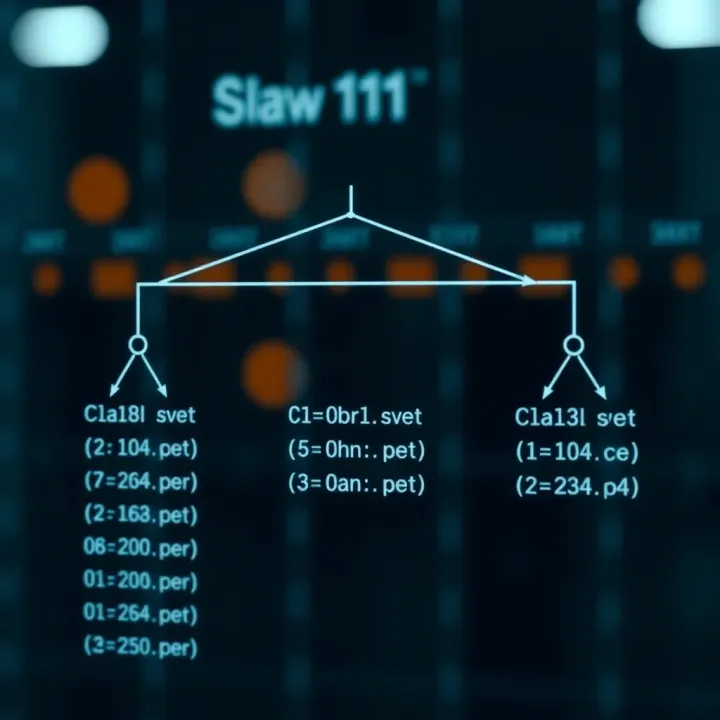
Here’s how insertion generally works:
Start at the root node.
If the tree is empty, the new element becomes the root.
Compare the new value with the current node’s value.
Move to the left subtree if the new value is less; otherwise, go to the right subtree.
Repeat steps 3 and 4 until reaching a null spot where the new node can be inserted.
This process ensures every insertion keeps the tree ordered, supporting fast search, delete, and update actions. For example, when inserting 50 into a BST with root 40, since 50 is greater, it moves to the right subtree. If that right child is null, 50 is inserted there.
Insertion impacts the tree's shape — an unbalanced BST might degrade performance to linear time, so understanding insertion helps avoid such pitfalls.
Knowing insertion inside out also aids developers in implementing applications like database indexing or memory management, where quick data access is crucial. Traders and analysts can benefit by using BSTs in algorithms that handle large datasets needing fast querying.
In the next sections, we will break down insertion step-by-step, discuss common challenges like tree imbalance, and suggest methods to keep the BST efficient even with many insertions.
A solid grasp of a binary search tree's (BST) structure is essential before exploring how to insert elements efficiently. Understanding the arrangement and rules governing BSTs simplifies navigating the tree and ensures accurate insertion points are found without unnecessary traversal.
A binary search tree is a specialised data structure where each node contains a key, and nodes are organised so that the left subtree of a node contains only keys less than that node’s key, while the right subtree contains only keys greater. This strict ordering makes searching, inserting, and deleting elements efficient compared to unsorted structures. For example, a BST helps in rapidly finding the price of a particular stock in a sorted list of share prices.
Each BST node consists of three parts: the key, a reference to the left child, and a reference to the right child. The key holds the actual data — for instance, an integer, string, or object representing an asset ID. The left and right child nodes connect to subtrees that maintain the BST property. In practical systems like trading platforms, such a node structure enables organising orders or assets in a way that supports quick lookups and dynamic updates.
The BST enforces an ordering rule: every node’s left child key must be less than the node’s key, and every right child key must be greater. This property extends recursively throughout the tree. It is this order that underpins BST’s efficiency, reducing average search time to O(log n). Consider a situation where you're searching for a particular transaction ID; BST ordering directs the search to either left or right branches, skipping irrelevant parts of the dataset.
BSTs offer faster searching than simple arrays or linked lists. Arrays require linear or binary search, but insertion or deletion needs shifting elements, consuming time. Linked lists demand linear search time. BSTs, when balanced, provide near-logarithmic search, insertion, and deletion times, which suits financial applications handling large and frequently updated datasets.
BSTs power many database indexing systems where fast retrieval of records matters. In stock trading platforms, BSTs can maintain ordered histories or portfolios, enabling quick filtering and updates. Similarly, software features like auto-completion use BSTs to organise prefix-based word entries for rapid suggestions. These applications highlight why understanding BST structures benefits software and data professionals in managing dynamic datasets effectively.
Remember, the structure of BST itself decides the speed and efficiency of data operations, making foundational knowledge vital for anyone working with complex data systems.
Understanding the exact steps involved in inserting a new element into a Binary Search Tree (BST) is vital for anyone working with data structures, especially in trading algorithms or stock analysis tools where quick lookup and update matter. The insertion process maintains the BST property, ensuring elements to the left are smaller and elements to the right are larger. This careful placement supports efficient searching later on.
Insertion starts at the root node of the BST. Each new value is compared with the current node’s key to decide whether to move left or right. For example, if you insert Rs 30,000 as a value representing a stock price point, and the root holds Rs 50,000, you’ll move left since 30,000 is less than 50,000. This comparison step repeats at each node until an empty spot is found.
This comparison strategy ensures the BST remains sorted, which is crucial when you want to query or traverse the tree later. Each decision filters the search space effectively, much like narrowing down a company by market capitalisation in a share portfolio.

After deciding the direction based on the comparison, you move to the left or right child of the current node. Continuing the earlier example, since 30,000 50,000, you go to the left child. If a node's left child is occupied, continue the comparison at that node; otherwise, you’ve found your spot.
This navigational process repeats down the tree, following the value comparisons, until the right empty leaf position is reached. It’s much like following a set of directional signs in a bazaar to reach the shop you want—each decision narrows down the path.
An empty position or null child pointer is the rightful place for your new node. Finding this position means the new element fits perfectly in the BST without violating ordering rules. For instance, suppose no nodes exist on the right side of a node containing Rs 40,000 and the incoming value is Rs 45,000. This empty right child position is where insertion happens.
Identifying these empty spots is key because inserting in the wrong place could disrupt the BST's search efficiency, leading to longer search paths – which you’d want to avoid, especially in high-frequency trading systems.
Once the empty position is located, a new node is created with the incoming key and linked by assigning this node as either the left or right child of the parent node found through navigation. This step solidifies the node’s place within the tree structure.
For example, after deciding Rs 45,000 belongs right of Rs 40,000 and confirming the right node is empty, a new node is created. Linking it properly maintains the BST’s integrity, enabling quick future searches and insertions. Incorrect linking can cause traversal errors or data loss.
Remember, the core of insertion is both about finding the right spot through comparisons and preserving the tree’s order by correct node placement. This balance keeps the data structure efficient and reliable for extensive use.
By mastering these steps, students, analysts, and developers can build or enhance systems that rely on BSTs for real-time data management, like portfolio tracking or financial decision support tools in Pakistan’s market context.
When inserting elements into a Binary Search Tree (BST), a few unique situations require special attention to ensure the tree maintains its properties and functions efficiently. This section sheds light on these such cases, focusing on duplicate values and inserting into an empty tree, both common scenarios with practical implications.
Handling duplicate values in a BST often depends on the specific application and its data requirements. One straightforward method is to reject duplicates outright, which keeps the tree free of repeated keys but may not suit all use cases. Alternatively, duplicates can be stored either consistently to the left or right subtree, typically by defining that equal values go to the right child during insertion. This approach preserves the BST property while allowing repeated keys.
Another practical method involves augmenting the BST nodes to hold a count of duplicates rather than inserting separate nodes. This is efficient where multiple identical entries represent quantity or frequency, such as counting word occurrences in text processing.
Allowing duplicates influences the tree's shape and performance. Inserting duplicates only to the right may cause right-heavy skewing, especially if many duplicates pile up, degrading search performance towards linear time in worst cases. For example, inserting many identical keys like 50, 50, 50 consecutively causes a chain of right children.
Conversely, using a count within nodes keeps the structure balanced but requires modification in traversal and search algorithms to handle these counts properly. Developers must weigh these trade-offs, considering whether exact duplicates impact tree depth or if tracking their frequency suffices.
Inserting the first node into an empty BST is straightforward but crucial. This step establishes the tree's root, the anchor point for all subsequent nodes. Since no nodes exist, this insertion does not involve comparisons or navigation. The new key simply becomes the root node, starting the structure from scratch.
This initial setup matters practically because all further operations hinge on this node. Mistakes here—like incorrect assignment—can cause the entire tree structure to fail or become inaccessible. For example, in programming implementations, forgetting to update the root reference leads to an empty tree even after insertions.
Besides placing the root node, initialising any related metadata or pointers is important for smooth operations. This may include setting parent pointers to null and ensuring left and right child pointers start as empty. Proper initialisation prevents unexpected behaviour during later insertions or traversals.
In real-world applications, such as in database indexing within a resource-limited environment, careful tree initialisation avoids costly errors that could degrade performance or result in data corruption. Essentially, this special case sets the foundation for reliable and efficient BST management.
Properly handling duplicates and empty-tree insertions ensures your BST remains organised, efficient, and robust, especially when working with complex or large datasets.
When you insert a new element into a binary search tree (BST), it changes the structure, which impacts how fast you can search or update data later. The height of the tree plays a major role because taller trees generally slow down operations. In the worst cases, if insertions happen in a certain order, the BST can become skewed, resembling a linked list rather than a balanced tree.
When a BST becomes unbalanced, its height increases beyond the optimal range. This means searching, inserting, or deleting takes longer because you have to traverse more nodes. Imagine a phonebook sorted alphabetically but all names starting with the letter "A" piled on one side. That side will be long and skinny, making it harder to quickly find an entry.
In a practical example, if you insert values in ascending order (like 10, 20, 30, 40), the tree grows more like a straight line increasing height with every node. This severely degrades search performance from O(log n) on average to O(n) in the worst case, which defeats the purpose of using a BST.
Skewed trees happen mostly when data is inserted in sorted order without any balancing steps. A right-skewed tree is where every node has only a right child; left-skewed trees are the opposite. In database indexing or memory management, such skewed trees cause lookup delays, which is a real problem when handling millions of records.
For example, if a trader’s application constantly inserts increasing timestamps to track transactions, the BST might skew right. Without fixing this, queries for older transactions become slower as the system has to follow a long chain of right children.
To keep the tree balanced, self-balancing variants like AVL and Red-Black trees automatically adjust after each insertion. AVL trees use strict height difference rules between subtrees, while Red-Black trees use colour properties to maintain balance.
In practice, these trees are widely used in database indexes where maintaining fast search times is critical. For a broker handling live market data, using a Red-Black tree ensures the system does not slow down as new data streams in constantly.
Rebalancing typically involves tree rotations—small reshaping steps that restore balance without rebuilding the tree entirely. Single or double rotations reposition nodes to maintain optimal height.
A real-world analogy: It’s like rearranging files in a cabinet not when it’s full, but regularly enough so you don’t have to waste time searching. In software managing real-time data, these rotations happen behind the scenes, keeping operations smooth without manual intervention.
Keeping a BST balanced during insertions improves search speed and ensures efficient data management, especially when handling large or sorted datasets.
In summary, understanding how insertion affects BST performance is key. By adopting self-balancing trees or applying rebalancing techniques, you prevent performance bottlenecks that skewed trees cause. This makes your data structure reliable for demanding applications, from trading platforms to database management.
Understanding where and how to apply insertions in Binary Search Trees (BSTs) helps appreciate their practical value. BSTs are not just academic; they support real-world systems requiring quick search, sort, and update operations. Let’s explore key applications and resource considerations.
BST insertions play a vital role in maintaining ordered indexes within databases. When new records come in, inserting indexing keys into the BST ensures that subsequent searches happen efficiently, typically in log-scale time rather than scanning the entire table. For example, a financial firm storing millions of transaction records will use BST-based indexing to find client records quickly without wasting computation power.
This is especially useful in environments with frequent insertions and queries, such as stock market databases where prices and transactions update every second. The BST keeps data sorted and accessible, helping deliver prompt responses to queries.
In text input scenarios like search engines or messaging apps, BST insertions help power auto-completion features. Each time a user types a character, the system may insert new vocabulary keys dynamically. The BST structure allows suggestions to be retrieved in alphabetical or frequency-sorted order quickly.
For instance, typing “Kar” on a local e-commerce site could prompt suggestions like “Karachi,” “Karandi,” or “Karchi shoes” by traversing the BST nodes added through today’s searches or inventory updates. This improves user experience by offering relevant results smoothly.
BSTs are helpful in environments where memory and CPU power are scarce, such as embedded systems or mobile apps operating under limited battery life and hardware. Insertions can be done dynamically with minimal overhead, and the tree maintains order without allocating extensive additional storage.
For example, a mobile stock trading app might use a BST to manage watchlists, ensuring updates (insertions) and lookups do not drain resources. Compared to large array or hash-based structures, BSTs offer space-savvy and quick access benefits.
While BSTs serve well for ordered data access, they may not always outperform other structures like hash tables or balanced trees (AVL, red-black) in every scenario. Hash tables provide faster insertions and lookups on average but lack ordered traversal, which BSTs excel at.
In Pakistani business software, choosing BSTs over arrays or linked lists can reduce response times in sorted queries, but if strict order is unnecessary, hash tables might be better. Also, self-balancing BST variants should be considered if maintaining performance after intensive insertions is critical.
Efficient insertion and retrieval in BSTs remain fundamental for applications where order matters and resources are limited. Practical use depends on balancing speed, memory, and the nature of data operations in real-world systems.
🔍 Learn to write an efficient binary search program in C++ with clear steps, examples of iterative & recursive methods, common pitfalls, and testing tips.

🔍 Learn how the binary search algorithm efficiently finds data in sorted structures, explores its steps, strengths, limits, and compares with other search methods.
Explore balanced binary trees 🌳—learn their types, how balance boosts data structure performance, key algorithms, challenges, and real-world uses.

🔍 Learn how binary search works in C++ with clear examples, tips, and common mistakes to avoid. Master this key algorithm for faster programming!
Based on 8 reviews