

Understanding Binary Heaps and Their Uses
Explore binary heaps 🏗️: their structure, key operations, types, how they're built, and real-world use in priority queues and sorting algorithms.
Edited By
Isabella Turner
Binary Search Trees (BSTs) are a key data structure used to organise information efficiently in computer science. They allow quick searching, inserting, and deleting of data, which makes them highly relevant for traders, investors, analysts, and students working with algorithms or financial software.
A BST is a binary tree where each node has a value, with the left child containing smaller values and the right child containing larger ones. This property keeps the tree ordered, enabling operations like search, insert, and delete to run in average time proportional to the height of the tree.
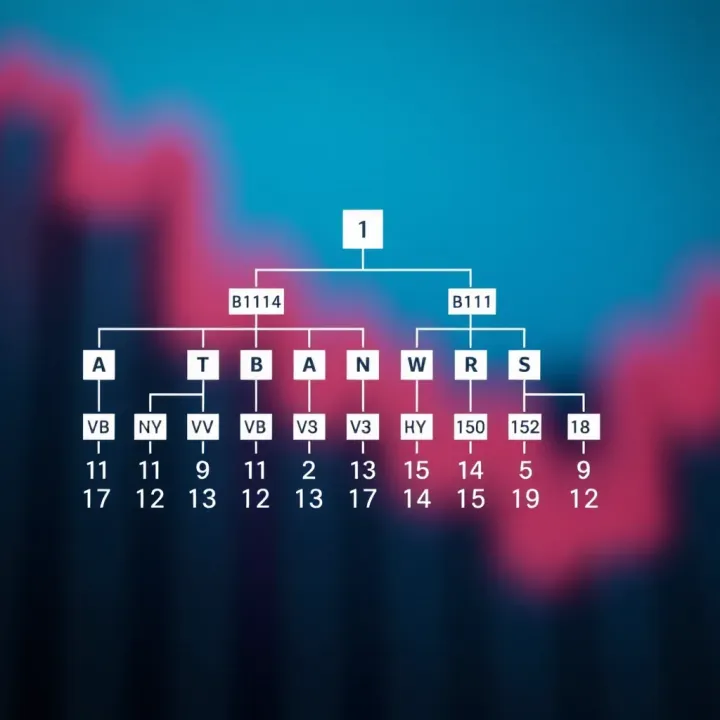
For example, imagine a BST storing stock prices. Finding the current price of a specific stock is faster than scanning a simple list because the tree directs you to the right section based on comparisons. The same applies to inserting new prices or removing outdated ones.
A well-balanced BST keeps operations efficient. If the tree becomes skewed (like a linked list), search times deteriorate to the worst-case linear time.
Common BST operations include:
Search: Compare the target value to node values, moving left or right accordingly.
Insertion: Find the correct leaf position where the new value fits to maintain order.
Deletion: Remove a node and adjust children nodes to preserve the BST property.
To prevent skewness, balancing methods such as AVL or Red-Black trees adjust the structure after insertions or deletions.
Besides algorithm implementation, BSTs are found in database indexing, symbol tables in compilers, and caching systems. In trading platforms, they help maintain real-time order books where fast lookups and updates are critical.
Understanding how BSTs function and their advantages in data handling equips you to grasp more complex data structures and improves your problem-solving skills, especially in financial modelling and software development.
This article will guide you through the detailed structure, operations, balancing techniques, and real-world applications of binary search trees for practical understanding.
Binary Search Trees (BSTs) form the backbone of many efficient searching and sorting applications. Their structured approach to organising data helps achieve fast search times, especially in datasets where random access is expensive or impossible. Understanding BSTs lays the groundwork for grasping more advanced data structures like balanced trees and heaps.
Each node in a BST typically contains three parts: the data value, a reference to the left child, and a reference to the right child. The data could be any comparable element—numbers, strings, or even complex objects with a defined order. This simple design allows nodes to link dynamically, enabling the flexible growth of the tree.
In practical terms, each node acts like a container holding the key information and pointers shaping the tree’s form. For example, if you are storing stock prices to quickly find where a particular price falls, the node's data is the price, while the references guide traversal.
In a BST, each node except the root has exactly one parent and up to two children—left and right. The left child’s key is always smaller than its parent’s, while the right child’s key is greater. This relationship creates a sorted hierarchy, making sure the search algorithms travel in the right direction without scanning unnecessary nodes.
This parent-child dynamic matters because it enables operations like insertion and deletion to modify the tree without losing order. For instance, when a new price is added in a trading system, this relationship dictates where it sits so queries remain efficient.
The defining property of a BST is that for any node, all keys in its left subtree are less than its own key, and all keys in its right subtree are greater. This invariant must hold throughout the tree, helping maintain order and guaranteeing efficient search, insertion, and deletion, generally averaging O(log n) time complexity.
This property differentiates BSTs from generic binary trees and supports applications where sorted data and quick look-ups are essential, like in database indexing or real-time data monitoring in financial markets.
BSTs provide faster average search times than basic binary trees due to ordering. Unlike heaps which prioritise minimum or maximum elements, BSTs organise all keys for range queries and predecessor-successor operations. Compared to hash tables, BSTs maintain order, which is vital for operations like nearest neighbour or sorted traversals.
In a trading context, this means BSTs allow queries like "find all stocks priced between Rs 500 and Rs 1000" far more naturally than hashing structures that lack inherent order.
BSTs are commonly used in searching, sorting, and maintaining dynamic ordered data collections. They underpin the symbol tables in compilers, organise filesystems, and accelerate database queries. Their ability to quickly insert, delete, and find elements makes them ideal for systems requiring frequent updates and real-time responses.
For example, an e-commerce site using BSTs can manage product prices efficiently, helping generate price-based filters or recommendations instantly during peak shopping events.
Understanding BSTs equips you with a versatile tool suited for diverse applications—from finance to software design—where orderly structure and fast access are non-negotiable.

Binary Search Trees (BSTs) depend on three fundamental operations: searching, insertion, and deletion. Mastering these operations is essential to understand how BSTs maintain organised data efficiently. Each operation affects tree structure and performance, so practical knowledge is key, especially when working with large datasets or performance-critical applications like trading algorithms or data indexing.
Searching in a BST follows a straightforward path. Starting from the root, the target value is compared with the current node’s key. If it matches, the search ends. If the target is smaller, the search moves to the left child; if larger, to the right. This process repeats until the value is found or a leaf node is reached. For example, a trader looking for a particular stock price point in a BST storing prices can quickly narrow down the search by this logic.
The average search operation runs in O(log n) time, where n is the number of nodes. This is because the search space halves at each step. However, in a poorly balanced tree, the worst case becomes O(n), similar to a linked list, which slows down performance. Efficient BST implementations often pair with balancing methods to ensure search operations stay fast, essential for applications that handle real-time data lookup such as brokerage systems or financial databases.
Inserting a node also starts at the root, using the same comparison approach as searching. The new node finds its proper place where the left or right child pointer of a leaf node is empty. For instance, adding a new security symbol to a trading platform’s BST helps maintain sorted order without re-sorting the entire data set. This method keeps insertion efficient and ensures the tree’s properties remain intact.
Handling duplicates in BSTs requires a defined strategy; common approaches include ignoring duplicates, storing a count within nodes, or inserting duplicates consistently on one side (usually right). This choice depends on the application's needs. For example, if trade volumes for the same price points are stored, keeping a count helps track occurrences without expanding the tree unnecessarily.
Removing a node with no children is the simplest case. The node is simply detached from its parent. This operation is quick and doesn't disrupt the overall BST structure, which is beneficial when handling volatile data where entries are quickly added and removed, such as live market orders.
When a node has a single child, the deletion replaces the node with its child. The parent node’s pointer is updated to the child, preserving the BST property. This keeps the tree balanced with minimal effort, which is crucial in systems where stable data retrieval is necessary despite frequent updates.
This is the most complex deletion case. Typically, the node is replaced with its in-order successor (smallest node in the right subtree) or in-order predecessor (largest in left subtree). Then, the successor/predecessor node is deleted using one of the simpler cases. For example, deleting a key from a symbol table in a compiler's BST would involve this process to maintain order without data loss.
Efficient BST operations are vital for building responsive systems in finance, data indexing, and resource management. Knowing how these operations work helps optimise performance and data integrity.
Search: Navigate left/right to find or confirm absence;
Insert: Attach new node at correct leaf position;
Delete: Remove nodes with adaptation depending on children count.
Understanding these fundamental processes gives you a solid foundation for exploring advanced BST variations and balancing techniques.
Balancing binary search trees (BSTs) is key to keeping their operations efficient. When a BST is balanced, it maintains a structure where the depths of subtrees do not differ widely. This balanced shape ensures that search, insertion, and deletion can usually complete in logarithmic time, which is crucial for performance-sensitive applications such as database indexing or real-time trading algorithms.
An unbalanced BST can degrade into a structure resembling a linked list if nodes keep adding to one side only. This degrades the usual O(log n) performance of search or insert operations to O(n), where n is the number of nodes. Imagine a trader's portfolio stored in a BST; if the tree becomes skewed, searching for a specific stock's data might slow down drastically, affecting timely decisions.
Examples of unbalanced structures include left-skewed or right-skewed trees. For instance, a sequence of increasing values inserted one after another typically produces a right-skewed tree. These heavily biased shapes mean that most operations run in linear time, losing the speed benefit that balanced BSTs provide. In practice, this can cause delays in software like stock trading platforms or inventory systems during peak loads.
AVL trees are BSTs that strictly maintain balance by keeping the difference in heights of left and right subtrees to at most one for every node. They perform rotations during insertions and deletions to restore balance immediately. This strict balancing makes AVL trees faster for search-heavy applications, such as those analysing market data streams, where rapid lookups are routine. However, the overhead of rotations might slow insertions slightly compared to other trees.
Unlike AVL trees, red-black trees allow a slightly looser balance, ensuring the longest path is no more than twice the shortest path length. They tag nodes with colours (red or black) and apply rules to maintain balanced distribution. This balance method offers efficient insertions and deletions, which suits applications where the data changes frequently, such as broker platforms updating client portfolios continuously.
Splay trees bring recently accessed elements closer to the root to speed up repeated access on those nodes. They don’t guarantee strict balance, but their self-adjusting nature works well when certain elements are queried frequently. In Pakistan's e-commerce or financial apps, splay trees can help access hot data quickly, reducing response times for common queries without the complexity of strict balancing.
Balanced BSTs make sure that your data structure doesn't become a bottleneck. Keeping the tree balanced is like maintaining a good road network — it prevents traffic jams in data retrieval and updates.
In summary, balancing BSTs enhances performance by avoiding skewed and inefficient tree shapes. Choosing between AVL, Red-Black, or Splay trees depends on the application’s specific needs—search speed, update frequency, or access patterns. Understanding these helps in building robust systems especially relevant to Pakistan’s growing tech and financial sectors.
Traversal methods are fundamental for accessing and processing data stored in binary search trees (BSTs). They allow us to systematically visit each node, ensuring that operations like searching, sorting, and printing can be done efficiently. For traders, analysts, and students working with algorithms or system implementations, understanding these traversal techniques is essential, as they underpin how BSTs yield ordered data and help in optimising real-world computations.
Algorithm explanation
Inorder traversal visits nodes in the sequence: left child, current node, right child. This systematic approach naturally produces the values stored in a BST in ascending order, making it particularly useful when you need sorted data. The implementation uses recursion or a stack to navigate all nodes, ensuring no node is missed.
Use cases and applications
This traversal suits scenarios where ordered outputs are necessary, for example, generating sorted listings of stock prices or financial transactions. It also aids in range queries, where you want to retrieve all items within certain bounds efficiently without scanning the entire tree.
Differences and practical uses
Preorder traversal processes the current node before its children, following the order: node, left child, right child. Postorder traversal, conversely, visits children before the node: left child, right child, node. Preorder is handy for copying or saving the structure of a BST, since it captures the root first. Postorder helps in tasks like deleting the tree, as it ensures child nodes are handled before parents.
Implementation details
Both traversals are often implemented recursively. For example, a preorder function calls itself first on the left child, then on the right, processing the node before these calls. Postorder does the opposite, processing the node after visiting children. In iterative approaches, stacks assist in tracking nodes to visit, avoiding overheads of recursive calls.
How it differs from depth-first traversals
Level-order traversal, or breadth-first traversal, visits nodes level by level, starting from the root and moving down horizontally. Unlike depth-first traversals (inorder, preorder, postorder) which go deep into one branch before others, level-order covers all nodes at each depth before descending.
Common applications
This method shines in scenarios like network routing or scheduling, where operations need to consider nodes grouped by their levels. It is often implemented with a queue to manage nodes layer by layer. For instance, in memory management or file system indexing, level-order traversal helps process data structures in a breadth-wise fashion, reflecting real-world hierarchies neatly.
Understanding these traversal methods enriches your ability to select the right approach for different problem settings, optimising performance and clarity in BST-related operations.
Inorder ensures ordered data access
Preorder supports structure copying
Postorder facilitates safe deletion
Level-order aligns with breadth-wise tasks
Mastering these traversal techniques is crucial for anyone dealing with BSTs to apply them effectively in algorithm design, financial data sorting, or software system development.
Binary Search Trees (BSTs) are widely used beyond theory—they play a key role in many practical computing tasks. Understanding their applications helps clarify why BSTs remain a favourite choice in programming and system design, especially where efficient search and data organisation are crucial.
Speeding up search queries: BSTs are fundamental in database indexing due to their ability to maintain sorted order and support fast search operations. When a query arrives, BSTs reduce the number of comparisons needed to find data compared to scanning the entire dataset. This makes lookups significantly quicker, which is especially valuable in large databases, like inventory management systems managing thousands of products or financial records with millions of entries.
Integration with other data structures: In many database systems, BSTs combine with structures like B-trees or hash tables to optimise data retrieval. While B-trees handle disk-based storage efficiently, BSTs can manage in-memory operations where fast insertions and deletions are required. This blend ensures that databases support both speed and scalability, catering to diverse query loads.
Organising files efficiently: File systems use BSTs to organise files based on names, timestamps, or sizes. This helps the operating system quickly locate or sort files, improving performance when users open folders with thousands of entries. For example, when browsing large photo collections, BSTs help index and access files without long delays.
Allocating memory blocks: Memory management units employ BSTs to track free and used memory blocks. When a program requests memory, the BST helps find the best-fitting block, optimising space and reducing fragmentation. This method speeds up allocations and deallocations, which is critical for systems running multiple applications simultaneously.
Symbol tables in compilers: Compilers maintain symbol tables to store identifiers like variable names and function definitions. BSTs organise these tables, allowing quick insertion and retrieval during compilation. This organisation reduces compilation time, especially in large projects with thousands of symbols.
Network routing tables: Routers often use BSTs to manage routing tables that guide traffic across networks. The tree structure helps quickly match destination addresses with the right paths, improving data packet delivery speed and network efficiency. In growing networks like those in large enterprises or service providers, BSTs contribute to smoother routing decisions.
BSTs blend simplicity with efficiency, supporting diverse real-world needs—from speeding up database queries to managing memory and routing information. Their role remains vital in systems demanding quick data access and reliable organisation.
Explore binary heaps 🏗️: their structure, key operations, types, how they're built, and real-world use in priority queues and sorting algorithms.
Explore balanced binary trees 🌳—learn their types, how balance boosts data structure performance, key algorithms, challenges, and real-world uses.

🔍 Learn how binary search works in C++ with clear examples, tips, and common mistakes to avoid. Master this key algorithm for faster programming!

🔍 Discover when binary search fails: unsorted data, specific structures, and limits. Learn better search methods for tricky cases in programming.
Based on 8 reviews