

Mastering Binary Search in C Programming
Learn binary search in C programming 🔍: sorting essentials, step-by-step code, real-world examples, performance tips, and common mistakes to watch out for.
Edited By
Liam Bennett
A binary search tree (BST) is a tree data structure commonly used to organise data for quick search, insertion, and deletion operations. In a BST, every node has up to two children: the left child contains values smaller than the node, while the right child holds larger values. This clear ordering makes BSTs efficient, usually offering average-case operations in O(log n) time.
Understanding BSTs is valuable for programmers working on applications such as database indexing, real-time data processing, or even algorithm design. For people involved in financial trading platforms or stock market analysis software common in Pakistan, BSTs help manage sorted data sets efficiently.
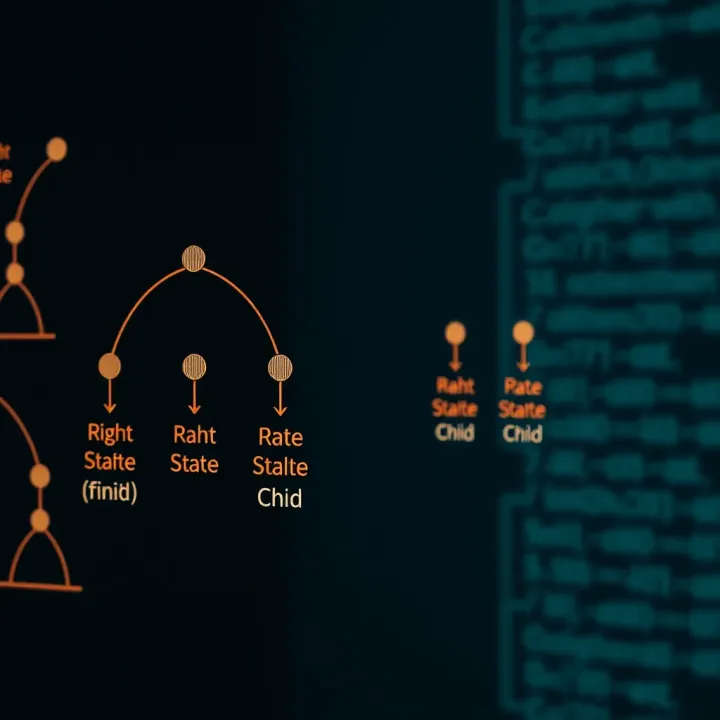
Implementing a BST in C requires defining the structure for nodes and writing functions for core operations:
Insertion: Adding new data while maintaining BST properties.
Searching: Finding whether a value exists in the tree.
Deletion: Removing nodes without breaking the tree's order.
Each node typically contains data and pointers to its left and right children. For example, a node storing an integer value looks like:
c struct Node int data; struct Node* left; struct Node* right;
> Remember, BSTs work best with unique or comparable values to keep the tree balanced for faster operations.

This article will guide you through writing these functions clearly, supported by examples, so you can apply BSTs to your projects. Whether you’re a student preparing for coding interviews or a developer building financial tools, mastering BSTs in C helps optimise data handling.

In the following sections, we will break down each operation step by step, ensuring you understand the logic as well as the code. This approach will make it easier to adapt BSTs for specific requirements, such as handling large data sets or creating custom tree structures tailored to your application’s needs.

## Getting Started to Binary Search Trees

Binary Search Trees (BSTs) offer a practical way to organise data for quick access and modification. In this article, gaining a solid grasp of BSTs is key, especially as you plan to implement one in C. Understanding their structure and behaviour helps you write efficient code that handles real-world tasks smoothly, whether it’s managing user records or stock price data.

### Basic Concept and Structure of a BST

A binary search tree is a special kind of binary tree where each node has at most two children, called left and right. The defining feature is the way values are arranged: values smaller than a node’s data go to the left subtree, while larger values go to the right. This organisation supports fast searching, similar to how a dictionary orders words alphabetically for quick lookup.

The practical benefit is clear — instead of scanning every element, BSTs enable you to zoom in on the desired value by eliminating half of the remaining data at each step. This greatly reduces the search time compared to unsorted structures such as linked lists.

#### Properties that make BST unique

BSTs impose ordering in their nodes, which balances flexibility and efficiency. Every left child holds a value less than its parent, and every right child holds a value greater. This property ensures no duplicates exist in a standard BST, which simplifies operations like insertion and deletion.

Thanks to this arrangement, processes like sorting and searching become more straightforward and predictable. For example, an inorder traversal of a BST visits nodes in ascending order, giving a sorted list without extra sorting steps.

#### Comparison with other tree data structures

Unlike general [binary](/articles/understanding-binary-search-c/) trees, which have no restrictions on node values, BSTs enforce a clear order which aids faster data handling. Compared to balanced trees like AVL or Red-Black trees, a plain BST doesn’t guarantee balanced height but is simpler to implement.

In Pakistani programming exercises and small applications, BSTs often serve as the starting point before moving on to balanced variants if necessary. They strike a good middle ground — offering decent [performance](/articles/understanding-binary-search-performance/) without complexity.

### Advantages of Using BST

#### Efficient data searching and sorting

BSTs typically allow search, insertion, and deletion in O(log n) time when balanced. This performance is a big advantage over simple lists, especially when your data grows large. For instance, searching a customer ID in a list of tens of thousands is far quicker with a properly maintained BST.

In the local context, where databases might face heavy reads and writes, implementing a BST tightly integrated with your program can shave off precious milliseconds, improving user experience.

#### Dynamic data organisation

BSTs adapt smoothly as data changes — you can insert or remove items without overhaul. Unlike [arrays](/articles/binary-search-arrays-cpp/) that may require shifting elements, BSTs manage pointers and preserve order naturally.

This makes them suitable for real-time systems, like financial apps dealing with ongoing transactions or tracking fluctuating stock prices, where data is frequently updated.

#### Use cases where BSTs perform well

BSTs shine in applications where quick lookup and sorting are needed but memory overhead must stay low. Examples include:

- Implementing symbol tables in compilers
- Managing indexed records in local files
- Autocomplete features in software where search speed matters

> For Pakistani developers, BSTs offer an efficient, understandable starting point before turning to complex structures, balancing ease with performance.

In summary, getting the basics of BSTs helps you build reliable programs that handle data logically and quickly, essential skills in today's tech environment.

## Setting Up the Binary Search Tree Program in

Setting up a Binary Search Tree (BST) program in C lays the essential groundwork for efficient data handling. This phase involves defining how each node will store data and connect with others, plus the methods to manage memory dynamically. For Pakistani programmers especially, such clear organisation helps in developing practical applications like student records management, e-commerce inventory, or even stock price tracking by keeping data sorted and accessible.

### Defining the Node Structure

The heart of a BST program is its node structure. Each node needs three components: the data itself, and pointers to both its left and right child nodes. The data field typically stores values such as integers or strings representing real-world information like product IDs or user grades. The left and right pointers link nodes following BST rules — left pointers point to smaller values and right pointers to greater ones. This structure ensures quick lookup and insertion, which matters when managing large datasets.

Memory allocation for nodes is another key aspect. Since the size of a BST is not fixed, nodes are usually created dynamically using functions like `malloc` in C. This helps assign memory space only when needed, saving resources especially on systems with limited RAM, common in many Pakistani environments. Proper memory handling also prevents leaks, ensuring the program remains stable through long runs.

Initialising the tree means setting the root pointer to NULL at the start. This represents an empty tree and prepares the program to build nodes as data arrives. Every insertion thereafter updates this root or its children accordingly. Without this basic setup, operations like adding or searching would fail or cause errors.

### Writing the Basic Functions

The insertion function is central to building the BST. It decides where each new node fits by comparing values recursively or iteratively. For example, if you insert student roll numbers, the function places smaller numbers on the left and bigger ones on the right, maintaining order. Understanding this helps avoid common pitfalls like unbalanced trees, which slow down searches.

Creating nodes dynamically ties back to memory management. Each insertion first allocates memory for a new node, assigns the incoming data, and sets child pointers to NULL. This step must be fault-tolerant; a failure to allocate memory properly might crash the program, so handling such cases is crucial for robustness.

Lastly, the main function brings everything together. It initialises the root and calls insertion, search, or traversal functions as needed. For instance, a CLI-based program for managing book titles in a Pakistani library could use the main function to accept user inputs, build the BST, and display sorted lists efficiently. Setting up the main function correctly ensures smooth user interaction and program flow.

> Properly setting up your BST program in C reduces bugs and boosts performance, making it a solid starting point for any data-centric project.

This setup phase is more than just code—it's the backbone that supports the entire BST's efficiency and reliability.

## Implementing Core Operations in the BST Program

Implementing core operations like insertion, searching, and deletion in a binary search tree (BST) is fundamental for building a functional and efficient data structure. These operations directly impact how quickly you can access and modify the data stored, which is especially important in applications dealing with dynamic datasets, such as stock market analysis or client databases in Pakistan.

### Insertion of Elements

**Rules for inserting nodes:** Insertion in a BST begins by comparing the new value with the current node’s data. If the new value is smaller, it moves to the left child; if larger, to the right child. This rule maintains the BST property, ensuring that all left descendants are smaller and right descendants larger than their parent node. This ordering is vital for efficient searching later on.

**Recursive vs iterative insertion:** Recursive insertion is handy for its simplicity and clear logic, calling the insert function repeatedly until the right spot is found. However, iterative insertion can be more efficient in terms of memory use as it avoids function call overheads—important when working on resource-limited systems or large datasets common in Pakistan's financial and tech sectors.

**Sample code with explanation:** Consider a recursive insertion in C:

c
struct node* insert(struct node* root, int val)
    if (root == NULL)
        struct node* temp = malloc(sizeof(struct node));
        temp->data = val;
        temp->left = temp->right = NULL;
        return temp;
    if (val  root->data)
        root->left = insert(root->left, val);
    else if (val > root->data)
        root->right = insert(root->right, val);
    return root;
This code creates a new node if the root is NULL; otherwise, it moves left or right based on the value comparison. It’s straightforward and easy to maintain.
How search works in BST: Searching exploits the BST's sorting property. Starting from the root, each comparison narrows down the search space by half, moving left if the target is smaller or right if larger. This halves the path length at every step, providing faster access than linear searches in arrays or unsorted lists.
Time complexity considerations: Ideally, searching in a BST takes O(log n) time, but it can degrade to O(n) if the tree becomes skewed, resembling a linked list. Hence, balancing the tree improves search efficiency, a key consideration when datasets grow really large.
Code snippets for search function: A typical recursive search function in C looks like this:
struct node* search(struct node* root, int val)
    if (root == NULL || root->data == val)
        return root;
    if (val  root->data)
        return search(root->left, val);
    else
        return search(root->right, val);
This function returns the node if found or NULL if not, helping you confirm presence or absence efficiently.

Handling node with no child: When the target node is a leaf (no children), simply removing it and setting its parent's corresponding pointer to NULL is enough. This is the simplest case with minimal adjustments.
Deleting nodes with one or two children: If a node has one child, you link the parent directly to this child, bypassing the deleted node. For two children, find the node’s inorder predecessor (rightmost node of left subtree) or successor, replace the target node’s value, then delete the duplicate node found. This keeps the BST property intact.
Implementation challenges: Deletion requires careful pointer adjustments to avoid memory leaks or broken trees. Managing all these cases cleanly in C demands attention to detail, especially handling NULL pointers safely, which has practical relevance in robust software development for trading platforms or inventory systems.
Mastering these core operations ensures your BST program can handle real-world data efficiently, which is essential for performance in dynamic applications across Pakistan’s business and tech environment.
Traversing a binary search tree (BST) means visiting all the nodes in a systematic way. This step is essential because it allows you to access and process every element stored in the tree. Whether you want to display the data, search for specific values, or perform any other operation, traversal helps you move through the tree efficiently.
Inorder traversal visits the tree nodes in a left-root-right sequence. This approach is particularly useful for BSTs because it returns the elements in ascending order. Imagine you have a BST containing stock prices recorded over time; inorder traversal will let you list these prices from lowest to highest easily, which can help in analysing trends.
Preorder traversal visits nodes in root-left-right order. This is helpful when you want to copy the tree or reconstruct it because it processes the root before its children. For example, if you're saving a BST's structure for a financial modelling application, preorder traversal captures the shape of the tree precisely, which you can then restore later without losing the data’s hierarchy.
Postorder traversal follows left-right-root order. This method is practical when you want to delete the tree or free memory because you visit child nodes before the parent. For instance, after completing analysis, postorder traversal can help release resources held by a BST without leaving dangling pointers, which is especially important in C where manual memory management is crucial.
Recursion fits naturally with tree traversal since each node’s left and right subtrees are themselves trees. Writing traversal functions recursively makes the code cleaner and easier to understand. In C, this approach minimizes boilerplate because the function calls itself for each subtree until it reaches the leaves, where it stops.
Displaying the traversal results is straightforward — you usually print node values as you visit them. For example, inorder traversal can print values in ascending order, useful for showing a sorted list of items like share prices or user IDs. Clear output helps in debugging and confirms that tree operations are working as expected.
Beyond simple viewing, traversal supports various applications. In financial tools, traversing BSTs helps in quick lookups and summarising data. For students and programmers, implementing traversals deepens understanding of data structures. Also, traversal underpins complex functions like balancing trees or calculating height, which improve program efficiency.
Traversal is more than just visiting nodes; it's a foundation for utilising BSTs effectively in real-world programming tasks, especially in a language like C where explicit control over data and memory is necessary.
Testing and optimising your Binary Search Tree (BST) program is essential to ensure reliability and efficiency, especially when handling real-world data in applications like financial analysis or inventory management. Without careful testing, bugs such as segmentation faults or memory leaks can cause crashes or slow performance, which is particularly troublesome for Pakistani developers dealing with large datasets or limited hardware.
Segmentation faults and memory leaks often arise due to improper memory access or failure to release allocated memory. For instance, if your BST program tries to access a NULL pointer or frees the same memory twice, it may crash instantly. Memory leaks, on the other hand, slow down the system as unused memory accumulates, which is a common issue in C programs without automatic garbage collection. Detecting these requires careful code review and use of tools.
Pointer misuse issues are another frequent problem in C programming. Since BST operations rely heavily on pointers (for node connections), incorrect pointer assignments or dereferencing can lead to unpredictable behaviour. For example, accidentally overwriting a node pointer instead of updating its child's pointer can break the tree structure. Such mistakes often lead to segmentation faults or corrupted tree states during traversals.
Debugging tools and methods play a crucial role here. Tools like GDB (GNU Debugger) allow stepping through your code to monitor pointer values and catch where the program crashes. Valgrind is also invaluable for detecting memory leaks and invalid memory accesses. Combining these tools with printf debugging helps isolate issues effectively. Pakistani programmers can run such tools easily on Linux or Windows environments, making testing practical even on modest computers.
Balancing the tree concept is key to maintaining efficient operations. An unbalanced BST can degrade into a linear structure, causing search or insert times to balloon from O(log n) to O(n). While fully balanced trees need advanced techniques like AVL or Red-Black trees, even simple strategies such as inserting elements in random order can help prevent extreme skewing. This keeps your BST performance steady as data grows.
Using iterative methods when suitable can cut down on stack usage caused by recursion, especially in resource-constrained environments. For example, iterative traversal functions using stacks or queues prevent deep recursive calls that might lead to stack overflow on large datasets. Iterative insertion and deletion routines can also improve runtime performance and reduce overhead.
Memory management best practices involve freeing nodes properly after deletion, avoiding dangling pointers, and allocating just enough memory to avoid wastage. In a BST, every node allocated with malloc must be freed using free once it's removed from the tree. Pakistani developers working with limited RAM should pay attention to this to avoid leaks that degrade system stability over long runs.
Testing and optimisation might feel tedious, but they are essential steps to build a robust, efficient BST program that can handle Pakistan’s growing data needs reliably. Implementing the right debugging practices and performance strategies will save time and resources in the long run.
Learn binary search in C programming 🔍: sorting essentials, step-by-step code, real-world examples, performance tips, and common mistakes to watch out for.

🔍 Learn how binary search works in C++ with clear examples, tips, and common mistakes to avoid. Master this key algorithm for faster programming!

🔍 Discover when binary search fails: unsorted data, specific structures, and limits. Learn better search methods for tricky cases in programming.

🔍 Learn binary search in Python with practical tips! Explore iterative & recursive methods, efficiency insights, and real-world use cases for smoother coding.
Based on 5 reviews